Studio Notes 01. The Design Process Behind Diagonale Scarf
First time designer’s thoughts
So I finally take the courage to design my pattern. I felt I should have done this long time ago, given the fact I almost always modify the original pattern anyways.
I want to start with something smaller and easier, but not too easy that it’s already out there everywhere. After the sample knit of City Walk Mini Scarf, I wanted to knit a narrow scarf in different style and colour, and then the idea of diagonal eyelet line came to my mind. It looks perfect for me - delicate, feminine, and elegant. That’s how Diagonale Scarf become my very first pattern.
The structure and six iterations
Yes on paper that sounds simple. It is a scarf that follows the basics of all long, narrow triangle scarf and features the popular i-cord edge, still I spent LOTS OF TIME polishing the design details.
In reality, it took me six times of sample iterations to finalize the design. A lot of spreadsheet time and last-minute re-draw decision before I was happy with it.
Here’s how the sample evolved, roughly in order:
- Version 1: Danish slip stitch border. My starting point was testing out a Danish slip stitch border for the edge.
- Version 2: i-cord edge. I switched to an i-cord edge instead, then unravelled it. I honestly can’t remember why anymore!
- Version 3: i-cord, for real this time. I settled on the i-cord edge, but I wasn’t happy with the increase rate. I think I was increasing every 7th row, and the triangle grew too slowly.
- Version 4: faster increases, first lace attempt. I changed the increase rate to every 4th row and started the lace section. Two problems showed up here (more on both below): the yarn looked too variegated even though it was a tonal colourway, and the eyelets looked unbalanced.
- Version 5: a calmer yarn. With the increase rate settled, I tested a less tonal yarn, but it was still a bit stripy.
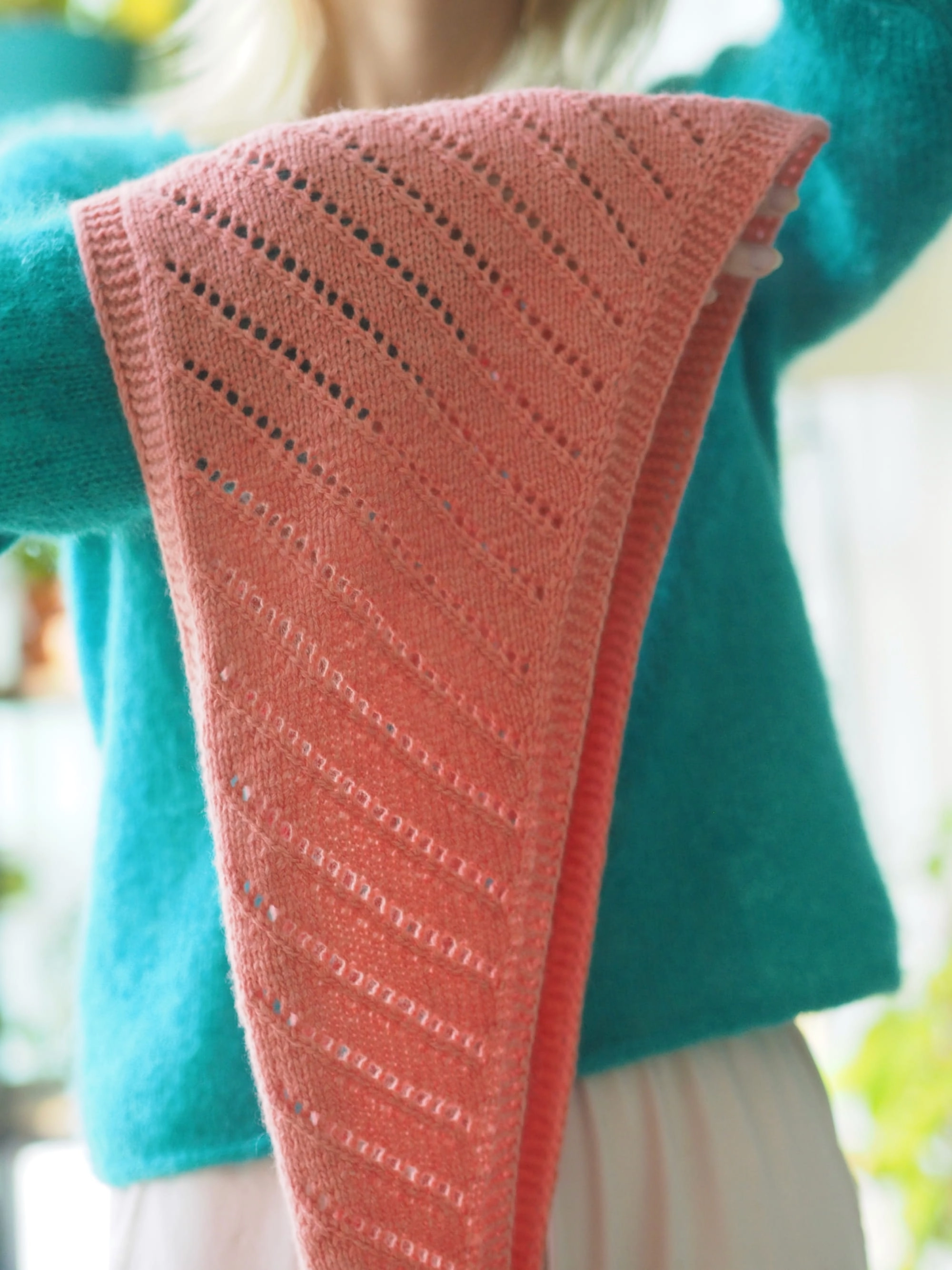
- Version 6: pink DK. I changed to a pink DK weight yarn and was very happy with the result. This is the sample you see in the photos.
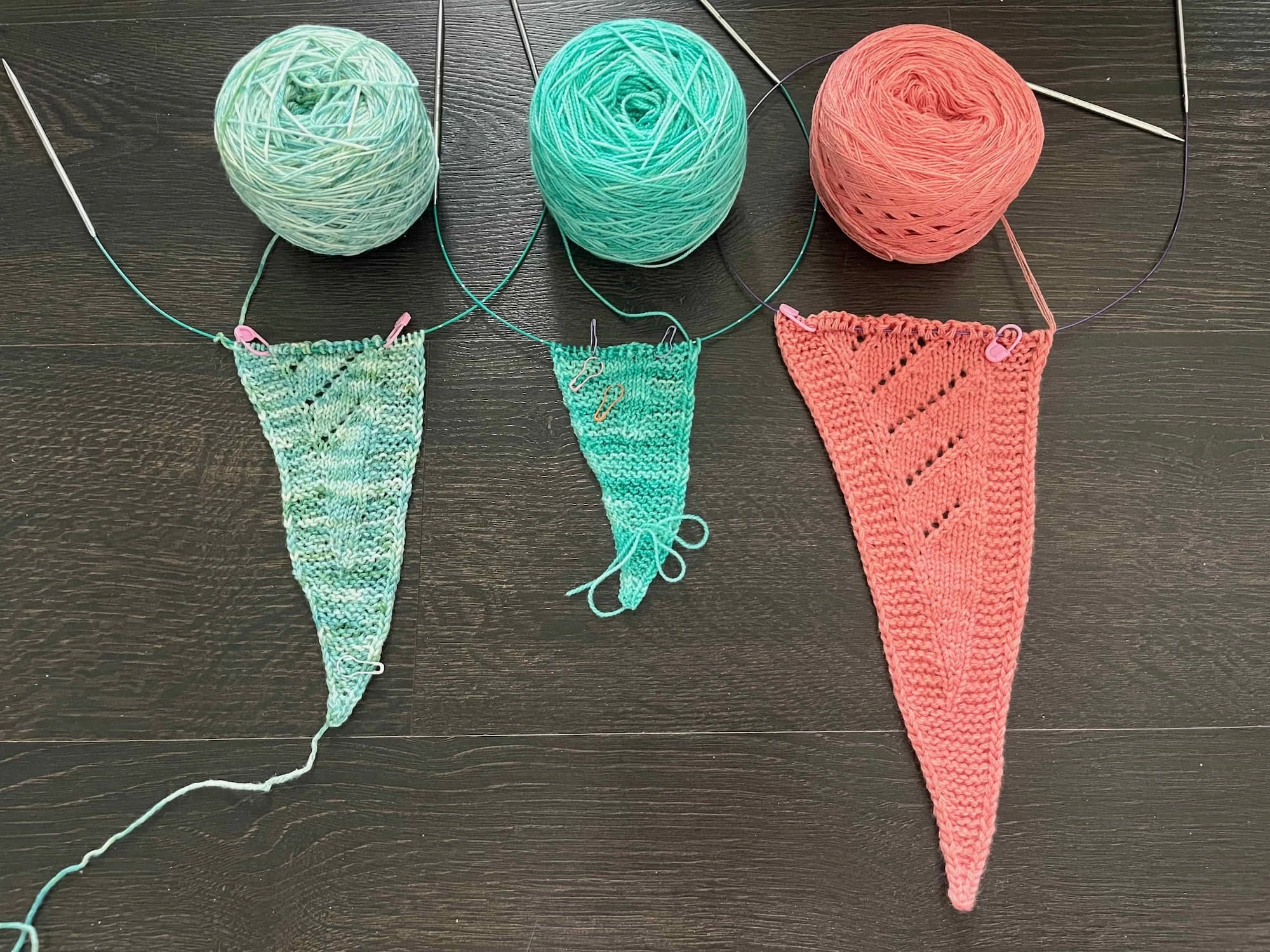
Figure 1: Version 4, 5 and 6
The colour turned out to be just as important as the stitch pattern. Diagonal eyelets are a fairly quiet texture, and any variegation in the yarn competes with them. Even a tonal yarn made the lace look busy in Version 4, and the less tonal yarn in Version 5 was still stripy. A solid pink DK finally let the eyelet lines show clearly.
The biggest problem of the whole design came from Version 4. The eyelets sat too close to the left end, and the whole lace section looked lopsided. It turned out to be maths: because of how the triangle grows, the average number of stitches on the left side of the lace was smaller than on the right side. If I simply repeated the lace motif across the row, the left side always ended up more crowded with eyelets.
So I couldn’t just use a plain lace repeat. I had to recalculate the lace and set up a few rules so that both sides match, as stated in the “Advanced tips” in the pattern. I made it optional intentionally, so that if the reader doesn’t want to track the chart and would rather knit by eye, this is the way to go.
Even with all the rules in place, I spotted another problem in the chart before I actually knitted that section: after the middle of the scarf, some eyelets appeared on their own instead of as part of a diagonal line. A lonely single eyelet looks like a mistake rather than a design choice, so I redrew the lace chart and shifted the eyelets so there aren’t any single eyelets left. Thankfully this does not impact anything I already knitted, only affecting the second half.
The writing is hard than I imagine
I’ve done plenty of modifications on other designer’s patterns before, but turning an idea into something a knitter can actually follow took much more time and effort than I imagined. I’m familiar with documentation and generally very good at writing tutorial, but one big issue I encountered during pattern writing is to decide how detailed do I want to be. On the one hand, I have to make sure I provide very clear instructions, on the other hand, I need to keep the language simple and has good readability without being too wordy, which, is the problem I often encountered.
I now get the dilemma: if I write the instruction too simple and high-level, beginners probably would have a hard time to follow; if I keep them too detailed and row-by-row, some people such as intermediate knitters might find it’s too wordly. Eventually I chose the middle ground: I provide both, but only keep the row-by-row instructions in the appendix so it’s not messed with the main content. I hope I made the right call.
Turned out that I spent a whole weekend tech editing the pattern, styling it, and drafting the call for test knitters. I wrote the whole pattern in org-mode and LaTeX, which I might explain in another day.
Renaming due to controversy
When I was calling for test knitters, people mentioned the original name “Diagon” is heavily associated with Harry Potter and will make people link to the current controversy around it. To be honest I’m not actively following news or social media but I had heard few things about J.K.Rowling so I have a brief idea. I personally can separate the franchise or products with the creator but I do understand people who don’t want to, and I would rather not to leave a negative impression due to the name itself. After some consideration and searching for alternative, I decided to go with simple and just rename it to Diagonale, which is the French word for Diagonal.